
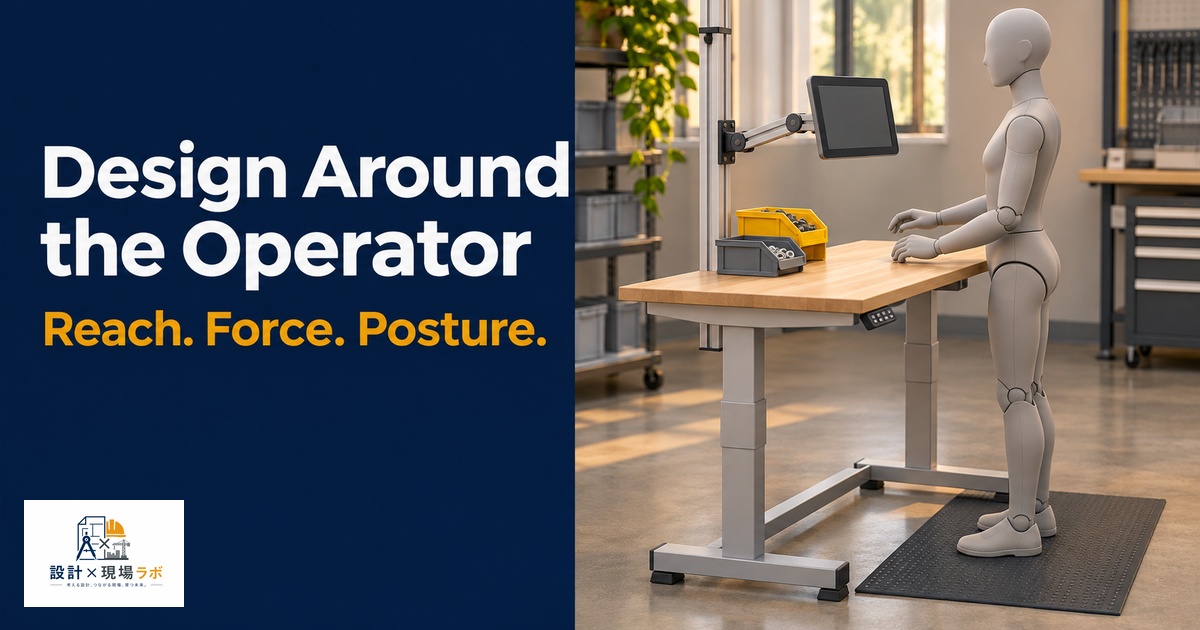
Twenty years of designing production machinery as a contract mechanical engineer inside Japanese manufacturing plants has taught me that ergonomics is rarely the reason a project gets approved, but it is very often the reason a project succeeds or quietly fails once it hits the floor. A machine that meets every functional spec but forces an operator to reach overhead a thousand times per shift will generate complaints, workarounds, and eventually a retrofit request that costs more than doing it right the first time would have. I have been called back to redesign load stations, adjust panel heights, and relocate controls on machines that worked perfectly well in every respect except the one where an actual human being had to interact with them for eight hours a day. This article walks through how I actually think about reach, force, and posture when I lay out a workstation, using real situations from projects I have worked on.
- Reach Envelopes Are Not One-Size-Fits-All
- Force Requirements and the Trap of Assuming Operator Strength
- Posture and the Cost of “It Works Fine in the CAD Model”
- Standing, Sitting, and the Question Nobody Asks Early Enough
- Repetitive Motion Frequency and Micro-Breaks Built Into the Cycle
- Working With, Not Around, the Plant’s Existing Ergonomics Program
Reach Envelopes Are Not One-Size-Fits-All
The standard anthropometric reach tables that get taught in ergonomics courses assume a population range, usually something like 5th percentile female to 95th percentile male, and designing to accommodate that full range sounds straightforward until you actually try to place a control panel that works for someone 150 centimeters tall and someone 185 centimeters tall on the same fixed height. I have learned that a single fixed panel height is almost always a compromise that serves nobody perfectly, and on any station with a wide range of operators, I now default to adjustable height platforms or panel mounts wherever the budget allows it.
On a manual inspection station I designed for an electronics assembly line, the original layout had a fixed-height work surface set at what the client’s engineering team considered a comfortable average. During time-and-motion observation before finalizing the design, I watched a shorter operator working with her shoulders elevated for an entire shift to reach the inspection fixture comfortably, while a taller operator on the same station was hunching forward. Neither posture is sustainable across a full shift, let alone years of shifts. I redesigned the station with a gas-spring height-adjustable work surface with a simple foot-pedal release, adding perhaps twelve thousand yen in hardware cost per station, and both operators reported the difference within the first week of use.
Reach distance matters as much as height. I generally keep frequently used controls and parts bins within a 40 to 45 centimeter forward reach from a neutral standing or seated position, reserving anything beyond 60 centimeters for items accessed only occasionally. On a kitting station I laid out for an automotive harness assembly cell, I initially placed a secondary parts bin at the rear of the bench, about 70 centimeters from the operator’s neutral position, because that was where the available floor space left room for it. Watching operators use the station, I saw them leaning and half-standing to reach that bin dozens of times per hour. I reorganized the bench layout entirely, moving high-frequency bins into the primary reach zone and pushing low-frequency items to the periphery, which required rethinking the whole parts presentation sequence but eliminated the repeated leaning motion.
Force Requirements and the Trap of Assuming Operator Strength
I have seen more than a few designs where a mechanism’s actuation force was calculated for function – enough force to seat a part, enough torque to close a clamp – without anyone asking whether a human operator could comfortably apply that force repeatedly across a shift. Peak force capability and sustainable repetitive force are very different numbers, and the gap between them is where a lot of repetitive strain injuries originate.
On a manual clamping fixture for a welding cell, the original toggle clamp mechanism required close to 15 kilograms of hand force to fully seat, which is within what most people can do once. Over a shift with several hundred cycles, though, that force requirement was generating real operator fatigue and complaints within the first month of production. I redesigned the clamp geometry to use a longer lever arm with a cam-assisted over-center action, which dropped the required hand force to around 5 kilograms for the same clamping force at the workpiece, simply by improving the mechanical advantage. The clamping performance did not change at all; only the human input required to achieve it changed.
I now try to design any mechanism an operator interacts with more than fifty times per shift to require no more than about 4 to 5 kilograms of applied force, using pneumatic assist, mechanical advantage, or powered actuation once a manual mechanism exceeds that threshold repeatedly. This is not a hard regulatory number in most cases, but it is the working target I have arrived at after watching which stations generate complaints and which do not.
Posture and the Cost of “It Works Fine in the CAD Model”
A machine that looks perfectly reasonable in a CAD model, viewed from a default isometric angle, can put an operator into a genuinely bad posture once it is built at full scale with a real person standing in front of it. I have made it a habit to build a simple cardboard or foam mockup of any new workstation before finalizing dimensions, and to physically stand at it myself, because a rendering does not tell you that a control is positioned in a way that forces internal rotation of the wrist, or that a viewing angle requires sustained neck flexion.
On a manual sorting station, the original layout placed the inspection screen directly above the parts bin, which seemed efficient on paper – operator looks down at parts, looks up at screen, minimal lateral movement. In the mockup, standing at the station myself, I realized the screen height forced a sustained upward neck tilt of close to 30 degrees, which is well beyond what is comfortable for sustained viewing. I relocated the screen to a position angled downward at roughly eye level with a slight forward tilt, which required extending the support arm and adding a articulating mount, but eliminated the neck strain entirely.
| Posture Factor | Problem Observed | Design Fix |
|---|---|---|
| Neck flexion | Screen mounted too high, forcing upward tilt | Lowered and angled screen to near eye level |
| Wrist deviation | Control lever angled for CAD convenience, not hand geometry | Rotated control axis to match natural wrist angle |
| Shoulder elevation | Fixed bench height too tall for shorter operators | Added height-adjustable platform |
| Trunk rotation | Secondary bin placed to the side, requiring twist | Repositioned bin within forward reach zone |
Standing, Sitting, and the Question Nobody Asks Early Enough
Whether a station should be designed for standing or seated operation seems like it should be an early decision, but I have seen it get decided almost by default, based on whatever similar station exists elsewhere in the plant, rather than by actually analyzing the task. A task that requires fine motor control and sustained attention for more than fifteen or twenty minutes at a stretch is usually better served by a seated station with proper leg clearance, while a task requiring frequent movement to adjacent stations or handling of larger, heavier parts is usually better as a standing station.
On a precision assembly cell for small electronic components, the plant’s initial concept had operators standing, matching the rest of the line. The actual task involved sustained fine motor work under magnification for extended periods. I pushed back on the standing default and proposed a sit-stand station instead, with a stool at a height that let operators alternate between sitting and standing without adjusting anything else, and with enough knee clearance under the bench for genuine seated use rather than a token stool that could not actually be used comfortably. The plant was initially resistant because sit-stand stations took slightly more floor space, but after a trial period, the line supervisor reported it directly reduced fatigue complaints during the afternoon shift decline that had been a known issue on that line.
Repetitive Motion Frequency and Micro-Breaks Built Into the Cycle
Beyond individual reach and force numbers, I have started paying attention to the total repetitive motion count a station design implies over a shift, because a motion that is individually reasonable can still become a problem at sufficient frequency. If a design requires a specific wrist or shoulder motion more than a few thousand times per shift, I look for ways to either reduce the motion count through better fixture design or introduce natural variation into the task cycle so the same exact motion is not repeated identically every single time.
On a screw-driving station, the original fixture required the operator to reach, pick, orient, and drive four screws in an identical sequence for every part, meaning the exact same wrist rotation happened over three thousand times per shift. I redesigned the parts presentation to use a rotating fixture that brought each screw location to the operator in a slightly different position relative to their body, which sounds like a small change but meaningfully varied the muscle groups engaged across the cycle rather than loading the same tendons identically every time. It was not a wholesale redesign, just a rethink of how parts were presented, but it addressed a repetitive strain risk that would have been invisible in a static ergonomic assessment focused only on peak force and reach distance for a single cycle.
Working With, Not Around, the Plant’s Existing Ergonomics Program
Most large manufacturers I have worked with in Japan already have an internal ergonomics or health and safety group with their own checklists and RULA or REBA assessment procedures, and I have learned that the most effective approach is to loop them in early rather than presenting a finished design for their sign-off. On a recent project, bringing the plant’s ergonomics coordinator into the layout review at the concept stage, rather than the final drawing stage, surfaced a reach issue on a secondary control that I would have otherwise only caught after building a prototype. Getting that kind of review early costs almost nothing in schedule terms and consistently catches issues that are expensive to fix once tooling and fixtures are already committed.

コメント