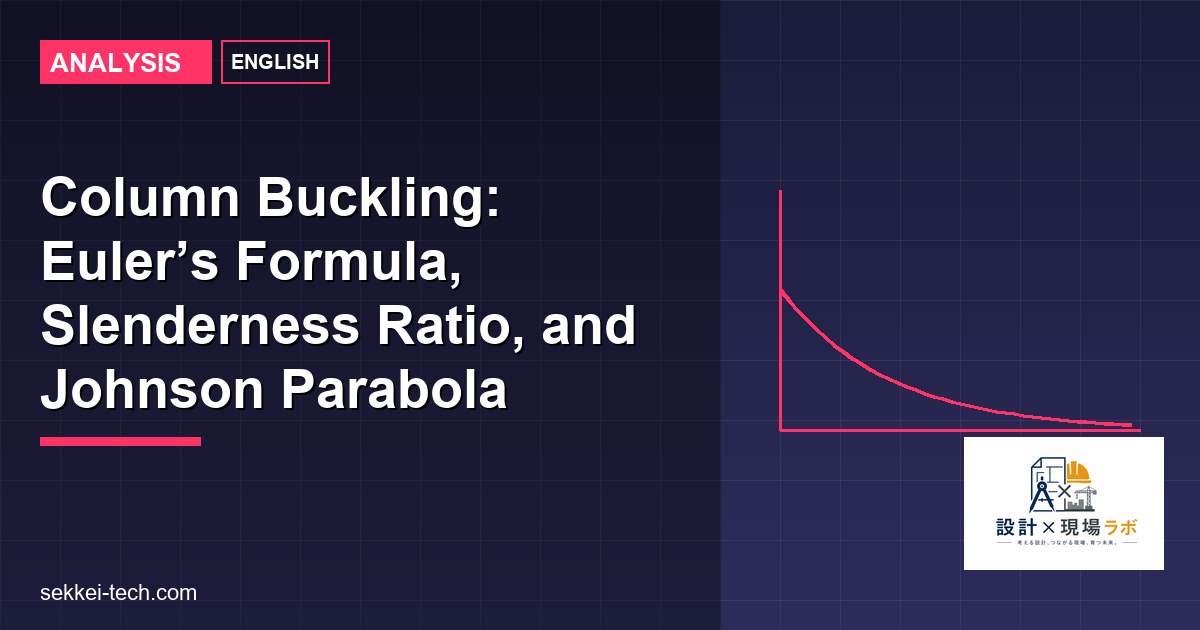
Column buckling is a sudden, catastrophic failure mode that occurs at loads well below material yielding — a structural column can buckle and collapse at a compressive stress of only 10–20% of the material’s yield strength if it is long and slender enough.
Buckling is an instability failure, not a strength failure. A perfectly elastic column under axial compression will suddenly deflect sideways when the critical (Euler) load is reached, even if every point in the column is stressed far below yield. Understanding the slenderness ratio, Euler’s formula, the Johnson parabola for short columns, and the effect of end conditions is essential for any engineer who designs structural columns, machine frames, struts, or press frames.
- Euler’s Critical Load Formula
- Effective Length and End Conditions
- Radius of Gyration and Slenderness Ratio
- The Slenderness Ratio and Column Classification
- Johnson Parabola for Short Columns
- Design Safety Factors for Columns
- Real Column Imperfections and AISC Column Curve
- Worked Example: Steel Column Buckling Check
- Conclusion
- Column and buckling formulas
Euler’s Critical Load Formula
For a long, slender, perfectly straight column with pinned ends (pin-pin), Euler’s formula gives the critical axial compressive load at which buckling occurs:
Pcr = π² × E × I / Le²
Where E = Young’s modulus (MPa), I = second moment of area (mm⁴) about the weak axis, and Le = effective length (mm). The Euler formula assumes elastic behavior — the material does not yield before buckling occurs. This assumption is valid only when the slenderness ratio is above a critical value (discussed below).
The critical (Euler) compressive stress is:
σcr = Pcr / A = π² × E / (Le/r)²
Where A is the cross-sectional area and r = √(I/A) is the radius of gyration. The quantity Le/r is the slenderness ratio SR — the single most important parameter governing column buckling behavior.
Effective Length and End Conditions
The effective length Le = K × L, where L is the actual column length and K is the effective length factor that depends on the end conditions:
| End Condition | K (theoretical) | K (recommended design) | Notes |
|---|---|---|---|
| Both ends pinned | 1.0 | 1.0 | Baseline case |
| Both ends fixed | 0.5 | 0.65 | 4× stiffer than pinned-pinned |
| One end fixed, one end pinned | 0.7 | 0.80 | 2× stiffer than pinned-pinned |
| One end fixed, one end free (cantilever) | 2.0 | 2.10 | Quarter the capacity of pinned-pinned |
| Both ends fixed, with sidesway | 1.0 | 1.20 | Sway frames |
The recommended design values (AISC, ASCE) are slightly more conservative than the theoretical values to account for real-world imperfections in end conditions. Fully fixed end conditions are difficult to achieve in practice — bolted connections with finite stiffness behave somewhere between pinned and fixed. For conservative design, use the theoretical K unless the connection rigidity is specifically verified.
Radius of Gyration and Slenderness Ratio
The radius of gyration r = √(I/A) is the distance from the centroidal axis at which the area would need to be concentrated to give the same second moment of area. For common sections:
| Section | r (weak axis) | Notes |
|---|---|---|
| Solid rectangle (b × h, b < h) | b/√12 = 0.289b | Buckling about weak axis |
| Hollow rectangle (OD B×H, wall t) | ≈ 0.289 × B for thin wall | More efficient than solid |
| Solid circle (diameter d) | d/4 | Equal in all directions |
| Hollow circle (OD D, ID d) | √(D²+d²)/4 | Very efficient |
| Wide flange (W-shape) | ry from steel tables | ry << rx |
Always check buckling about the weak axis (smallest r). For wide-flange columns in structural steel, ry (about the weak y-axis) is typically 3–4 times smaller than rx, so weak-axis buckling governs unless lateral bracing is provided.
The Slenderness Ratio and Column Classification
The slenderness ratio SR = Le/r determines which formula applies:
- Long columns (SR > SRc): Euler’s formula is applicable. The critical stress is below the proportional limit, and failure is elastic buckling.
- Short columns (SR < SRc): Yielding occurs before buckling. Use the Johnson parabola or direct yielding check.
- Intermediate columns: A transition zone between the two. Both yielding and elastic buckling interact.
The critical slenderness ratio SRc is the boundary between long and short column behavior:
SRc = π × √(2E / Sy)
For steel (E = 200 GPa) with Sy = 250 MPa: SRc = π × √(2 × 200,000/250) = π × √1600 = π × 40 = 125.7. For Sy = 345 MPa (A572 Grade 50): SRc = π × √(2 × 200,000/345) = 107. Columns with SR > 125 (for Sy = 250 MPa steel) are governed by Euler buckling; shorter columns are governed by the Johnson formula.
Johnson Parabola for Short Columns
For columns with SR < SRc, the Johnson parabola provides a smooth transition between yielding (SR = 0) and the Euler limit (SR = SRc):
σcr = Sy − (Sy² / (4π²E)) × SR²
At SR = 0: σcr = Sy (pure yielding). At SR = SRc: the Johnson parabola meets the Euler curve. The Johnson formula accounts for both material yielding and elastic instability, making it appropriate for the intermediate range of column slenderness that is most common in machine design (SR = 40–120).
Design Safety Factors for Columns
The allowable compressive load Pallow = Pcr / n, where n is the safety factor against buckling. Recommended safety factors for column design:
- Structural steel columns (AISC LRFD): φc = 0.90 (capacity reduction factor) — this implicitly provides n ≈ 1.7–2.0
- Machine design columns with well-defined loads: n = 2.0–2.5
- Columns with uncertain load or boundary conditions: n = 3.0–4.0
- Columns with possibility of dynamic loads or impact: n = 3.5–5.0
The higher safety factors for columns versus beams are justified because column buckling is a sudden, catastrophic failure mode with essentially no warning, unlike beam yielding which develops gradually and may allow redistribution of loads before collapse.
Real Column Imperfections and AISC Column Curve
Euler’s formula applies to perfectly straight, concentrically loaded columns — conditions that never exist in reality. Real columns have initial bow (out-of-straightness, typically L/1000 for structural steel per AISC), residual stresses from rolling or welding (up to 30–40% of yield), and eccentricity of applied load. These imperfections significantly reduce the actual buckling capacity below the theoretical Euler load, particularly for intermediate slenderness ratios (SR = 60–120).
The AISC column curve (AISC 360-16, Chapter E) incorporates these real-world effects through the expressions:
For λc ≤ 1.5 (short to intermediate columns): Fcr = 0.658^(λc²) × Fy
For λc > 1.5 (long columns): Fcr = (0.877/λc²) × Fy
Where λc = (KL/rπ) × √(Fy/E) is the column slenderness parameter. This curve provides a more accurate (and typically more conservative than Euler) prediction for real structural steel columns.
Worked Example: Steel Column Buckling Check
A 3000 mm tall machine frame column uses a 50 mm × 50 mm × 5 mm steel square hollow section (SHS). Both ends are pin-connected (K = 1.0). Applied compressive load P = 80 kN. Material: S275 steel (Sy = 275 MPa, E = 200 GPa). Check adequacy.
Section properties for 50×50×5 SHS: A = 4 × 50 × 5 − 4 × 5² = 1000 − 100 = 900 mm². I = (50⁴ − 40⁴)/12 = (6,250,000 − 2,560,000)/12 = 307,500 mm⁴. r = √(307,500/900) = √341.7 = 18.49 mm.
Slenderness ratio: SR = KL/r = 1.0 × 3000/18.49 = 162. Critical SRc = π√(2×200,000/275) = π√1454.5 = 119.4. Since SR = 162 > SRc = 119.4, use Euler’s formula.
Pcr = π² × E × I / Le² = π² × 200,000 × 307,500 / 3000² = π² × 6.833 × 10¹⁰ / 9,000,000 = 75,020 N = 75.0 kN. Pallow = 75.0 / 2.5 = 30.0 kN. Applied P = 80 kN > 30 kN — column is inadequate. Need to increase section size or add intermediate bracing.
Conclusion
Column buckling analysis begins with the slenderness ratio SR = Le/r and the critical slenderness SRc. For SR > SRc, apply Euler’s formula; for SR < SRc, use the Johnson parabola. Always use effective length Le = KL with the appropriate K factor for the actual end conditions. Apply safety factors of 2.5 or higher for machine design columns to account for load uncertainty and imperfections. For structural steel columns, the AISC column curve provides a code-calibrated, real-world-accurate capacity that accounts for initial bow, residual stresses, and other practical imperfections.
Column and buckling formulas
Column and buckling formulas are tabulated in:
Roark’s Formulas for Stress and Strain
Shigley’s Mechanical Engineering Design
As an Amazon Associate I earn from qualifying purchases.