
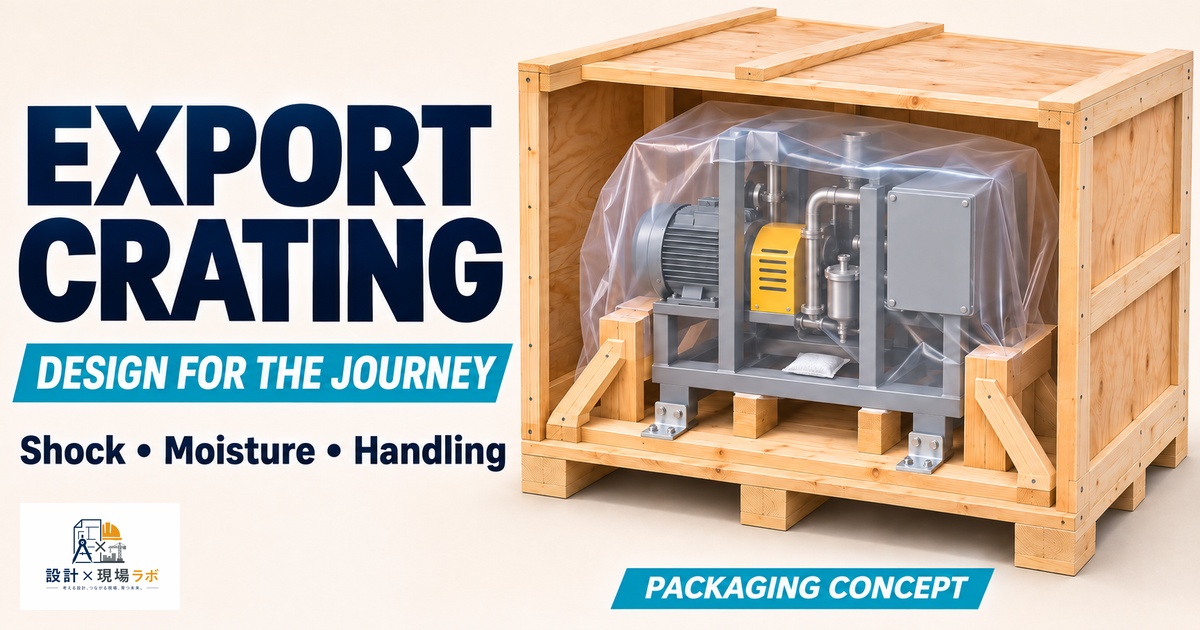
Twenty years of designing mechanical equipment in Japan has taught me a hard truth: a machine that survives design review, assembly, and factory acceptance testing can still arrive at its destination as scrap metal if the crate was an afterthought. I have watched a beautifully engineered conveyor module get shipped to a customer in Southeast Asia with packaging that looked adequate on paper, only to arrive with a bent frame and a cracked gearbox housing because nobody modeled what forty days on a container ship actually does to a machine. Export packaging is not a shipping department problem you hand off after the drawings are released. It is a design discipline in its own right, with its own failure modes, its own calculations, and its own set of stakeholders who need to be in the room early. This article walks through how I approach crating and export packaging design after two decades of watching machines leave the factory and, sometimes, not survive the trip.
- Why Export Packaging Is a Design Problem, Not a Shipping Problem
- Modeling the Shock and Vibration Environment
- Choosing Between Crate, Case, and Skid
- Center of Gravity, Lifting Points, and Load Paths
- Vibration Isolation and Internal Bracing
- Moisture, Corrosion, and Climate Considerations
- Documentation, Markings, and Regulatory Compliance
- Working With Logistics Partners Early
Why Export Packaging Is a Design Problem, Not a Shipping Problem
Early in my career I treated packaging as something that happened after the real engineering was done. The machine got designed, built, tested, and then someone in logistics figured out how to box it up. I learned how wrong that assumption was on a project involving a precision inspection fixture bound for a customer in Europe. The fixture had a granite base plate mounted on isolators, and the packaging team built a standard wooden crate with foam padding around the perimeter. Nobody had asked what happens when that crate gets tipped ninety degrees during a forklift transfer, which it did, twice, according to the tilt indicator. The granite base cracked along a stress riser near a mounting hole.
The lesson stuck with me: packaging design has to start at the same time as the machine design, not after it. When I now review a new project that will ship overseas, I ask the mechanical design team to identify the center of gravity, the most fragile subassemblies, and the components that cannot tolerate shock loading before the general arrangement drawing is even frozen. That information shapes how the machine gets broken down for shipment, which fasteners get temporary shipping brackets, and where the crate needs internal bracing. Treating packaging as a downstream afterthought guarantees that someone eventually has to reverse-engineer fragility information that should have been captured naturally during design.
Modeling the Shock and Vibration Environment
One of the most useful things I ever did was sit down with actual accelerometer data from a previous ocean shipment and look at what the machine had actually experienced versus what our packaging spec assumed. The difference was sobering. Our internal standard assumed a peak shock of around 2.5G for handling events, based on an old military packaging reference. The real data from a container ship crossing showed transient shocks above 6G during rough port handling, particularly during crane lifts and rail transfers where the container gets set down hard.
Since then, I insist on designing crates around actual measured data whenever we have access to it, and around conservative industry references such as ASTM D4169 distribution cycle testing when we do not. For a large stamping press transfer unit I worked on, we built the crate structure to survive a 3G vertical shock and a 1.5G lateral shock without any component shifting more than 2mm relative to its mounting. That meant calculating the natural frequency of the packaged assembly on its isolators and making sure it stayed well clear of the vibration frequencies typical of truck transport, which cluster in the 2 to 20 Hz range depending on suspension type. A crate that resonates at 8 Hz sitting on a truck bed for a twelve-hour highway leg will shake a machine apart even if it survives every individual shock event.
Choosing Between Crate, Case, and Skid
Not every machine needs a full sheathed export crate, and one mistake I see repeatedly from less experienced designers is over-specifying packaging because it feels safer. A heavy, rigid, low-fragility item like a cast iron machine base can often ship perfectly well on a simple skid with edge protection and strapping, saving significant weight and cost. On the other hand, a machine with exposed sensors, pneumatic lines, or delicate linear guides genuinely needs a fully enclosed, moisture-barriered crate.
I worked on a project shipping a robotic welding cell to a customer in South America where the shipping route included a lengthy period in a humid port warehouse before final inland transport. We chose a vapor barrier bag with desiccant inside a full plywood crate, rated for the estimated transit and dwell time based on the desiccant’s moisture absorption capacity. That decision came directly from knowing the actual logistics chain, not just the port of origin. If I had assumed a fast, direct shipment and used a simpler open crate, the electrical cabinets would likely have taken on condensation damage during the three weeks the container sat in a humid yard waiting for customs clearance. Matching the packaging tier to the actual logistics profile, not a generic assumption, is one of the most cost-effective decisions you can make on an export project.
Center of Gravity, Lifting Points, and Load Paths
A crate is only as good as its ability to transmit load from the machine’s actual weak points into the crate structure and then into the forklift pockets or crane lift points. I have seen crates designed with beautiful, symmetric skid bases that completely ignored the fact that the machine inside had its center of gravity offset by 300mm because of an integrated hydraulic power unit mounted to one side.
On a large fixture project, we calculated the actual center of gravity from the CAD model mass properties and marked it clearly on the crate exterior, along with the correct forklift entry orientation. We also designed internal cross-bracing so that the lifting load path ran through the machine’s structural frame members rather than through brackets or covers that were never meant to carry weight. I have personally seen a machine get lifted by its sheet metal enclosure because the crate did not make clear where the structural mounting points were, and the enclosure deformed permanently. Every export crate I sign off on now includes a lift point diagram and a center of gravity marking as standard practice, because the people handling that crate on the receiving end usually have never seen the machine and are working from the crate markings alone.
Vibration Isolation and Internal Bracing
Getting the exterior crate strong enough is only half the job. Internal bracing has to hold the machine rigidly enough that it cannot shift, while still isolating it from the highest frequency shocks that transmit straight through a rigid connection. This is a genuine design tension, and I have gotten it wrong before. On an early project, we bolted a machine solid to the crate floor with no isolation at all, reasoning that a rigid connection meant nothing could move. The machine arrived fine structurally, but several precision-mounted proximity sensors had drifted out of calibration because high-frequency shock transmitted directly through the rigid mounts into sensitive components.
After that experience, I started specifying isolation mounts, typically elastomeric or foam block isolators sized to the actual weight distribution, anywhere delicate instrumentation was involved, while keeping heavy structural items rigidly braced. The key is matching isolator stiffness to the mass it supports so the resulting natural frequency sits outside the dominant excitation range of the transport mode. For a truck-heavy logistics route, I aim to keep isolated natural frequencies below 5 Hz or well above 25 Hz, avoiding the 8 to 15 Hz band where most truck suspension energy concentrates.
Moisture, Corrosion, and Climate Considerations
Machines shipped from a temperate climate into a tropical or coastal destination face a corrosion risk that is easy to underestimate if you have not personally seen the damage. I once opened a crate that had sat in a humid customs warehouse for six weeks and found surface rust forming on precision-ground shafts that had been bare metal with only a thin coat of preservative oil. The oil had simply not been rated for that kind of prolonged humidity exposure.
Since then, for any shipment heading to a high-humidity region, I specify VCI, vapor corrosion inhibitor, paper or bags around exposed metal surfaces in addition to a heavier preservative coating than we would use domestically, and I always add desiccant sized to the enclosed air volume plus a margin for the barrier bag’s permeability rating. It is a small added cost relative to the value of the machine, but it is the kind of detail that gets skipped when packaging is treated as a checkbox rather than an engineering deliverable.
Documentation, Markings, and Regulatory Compliance
Export crates carry information that has to be legible and correct to people who may not read the language the machine documentation was written in. ISPM 15 wood treatment stamps for any solid wood packaging material are mandatory for most international destinations, and I have personally dealt with a shipment held at customs for over a week because the crate lumber lacked the proper heat-treatment stamp. That delay cascaded into a missed installation window and a very uncomfortable conversation with the customer about schedule.
Now, every crate design package I release includes a checklist covering ISPM 15 compliance, handling symbol placement per ISO 780, tip-and-tell or shock indicator placement where warranted, gross and net weight markings, and center of gravity and lifting point diagrams in both text and pictogram form. None of this is exotic engineering, but it is exactly the kind of detail that, when missing, turns a well-designed machine into a customs delay or a damaged asset before it ever reaches the customer’s floor.
Working With Logistics Partners Early
The single biggest improvement I have made to my own export packaging process over the years was simply inviting the freight forwarder into design reviews earlier than felt necessary. On a project shipping a large automated assembly line to a customer overseas, our forwarding partner flagged during an early design review that the container we planned to use had internal door clearance about 40mm less than our crate width, information that would have caused a very expensive redesign if discovered after the crate was built.
I now treat the logistics chain, container type, port handling equipment, inland transport method, and expected dwell times, as an input to the packaging design on the same level as the mechanical loads. A crate engineered in isolation from the actual shipping plan is a crate engineered against the wrong requirements. After twenty years of watching machines travel around the world, the packaging decisions that matter most are rarely about clever crate joinery. They are about understanding, in specific and concrete terms, exactly what that machine is going to experience between the factory floor and the customer’s receiving dock, and designing against that reality rather than a generic assumption.


コメント