
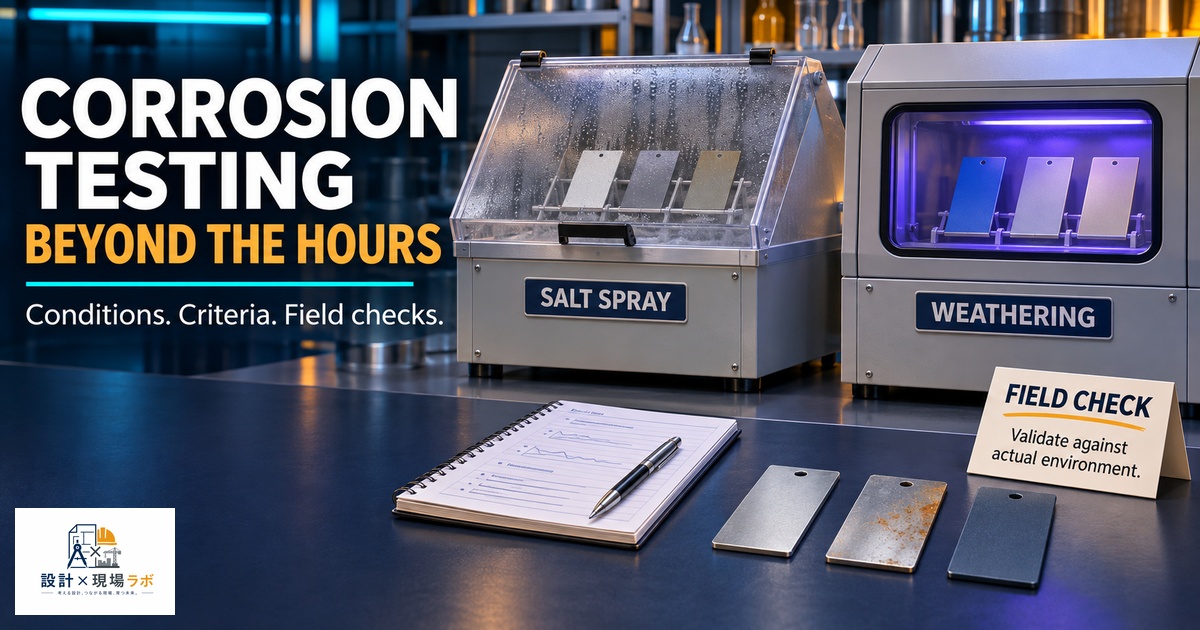
Twenty years of designing mechanical equipment for manufacturing plants has taught me that corrosion is one of those failure modes everyone acknowledges in theory and underestimates in practice. A bracket that looks perfectly fine on the drawing can be a rust streak within eighteen months if the plating spec was wrong or the test data behind it was misread. Salt spray testing and accelerated weathering are the two tools most of us reach for when we need to defend a material or coating choice to a customer, but both come with sharp limitations that I only fully understood after being burned by them more than once. In this article I want to walk through how I actually use these tests on real projects, where they mislead you, and how I combine them with field data to make decisions I can stand behind.
Why Salt Spray Testing Became the Default
Salt spray testing, standardized as ASTM B117, has been around since the 1930s, and it survives mostly because it’s cheap, fast, and everyone already has the chamber. You hang parts in a cabinet, atomize a 5% sodium chloride solution at a controlled temperature, and count hours until red rust or white rust appears. On a project I worked on for an outdoor equipment enclosure, the customer’s spec simply said “must survive 500 hours salt spray, no red rust,” and that single line drove the entire plating decision for every fastener and bracket on the assembly.
The appeal is obvious: it’s a pass/fail number that procurement and quality departments can put in a spec sheet without needing a corrosion engineer to interpret it. I’ve leaned on it myself when comparing two zinc plating suppliers who quoted wildly different prices — running both sample sets through the same chamber gave me an objective tiebreaker that neither supplier could argue with.
Where Salt Spray Testing Falls Apart
The problem is that salt spray hours don’t translate to real-world years in any reliable way, and I learned this the hard way early in my career. I once ran into a case where a fastener passed 240 hours of salt spray with flying colors, but the same coating failed within a single humid summer at an actual coastal facility. The chamber environment is constant, saturated, and warm — real environments cycle between wet and dry, which is actually harsher on many coatings because repeated wetting and drying concentrates salts and stresses the coating through expansion and contraction that a static salt fog never replicates.
I’ve also seen engineers misuse the test by assuming a linear correlation, like “twice the hours means twice the field life.” That’s not how it works. Different failure mechanisms dominate at different exposure durations, and a coating that resists early pitting can still degrade faster later through mechanisms the chamber never triggers. When a vendor hands me a salt spray certificate, I now always ask what substrate, what coating thickness, and what specific standard was used, because B117 results are not interchangeable with cyclic corrosion test results even when both are reported in “hours.”
Bringing in Accelerated Weathering
Salt spray only tests corrosion resistance in isolation, so for equipment that sits outdoors or near windows, I pair it with accelerated weathering — typically QUV or xenon arc testing per ASTM G154 or G155. These chambers cycle UV exposure, humidity, and sometimes heat to simulate sunlight and rain degrading coatings, plastics, and paints over months or years of compressed testing time.
On a project involving an outdoor control panel housing, the polycarbonate window and the powder coat finish both needed weathering data, not just salt spray data, because the failure mode we were worried about was UV-induced yellowing and chalking, not corrosion. I specified 1000 hours of QUV-B exposure and compared color shift with a spectrophotometer against the customer’s acceptance criteria. What surprised the customer was that the powder coat held up fine, but the clear polycarbonate window yellowed noticeably faster than the vendor’s datasheet suggested, because their datasheet was based on a UV-stabilized grade that wasn’t actually what got shipped on our first batch.
Combining the Two Tests for a Realistic Picture
Neither test alone tells the whole story, so on equipment destined for genuinely harsh environments — coastal plants, chemical processing areas, outdoor agricultural machinery — I now specify cyclic corrosion testing that combines salt fog, dry-off, and humidity cycling, following something closer to ASTM D5894 or a customer-specific cyclic protocol. It costs more and takes longer, sometimes six to twelve weeks instead of the two weeks a straight B117 run needs, but it correlates far better with actual field performance because it stresses the coating through the same wet-dry cycling that causes real damage.
I remember a machine base going to a fish processing plant, an environment with near-constant washdown, salt exposure from the process itself, and temperature swings from hot water cleaning to cold storage nearby. Straight salt spray data alone would have told us almost nothing useful, because the thermal cycling was doing as much damage as the salt. We ran cyclic testing that incorporated a hot water rinse step to mimic the washdown procedure, and that test actually predicted the coating breakdown pattern we later saw in the field within about ten percent of the timeline.
Reading Vendor Data Critically
A recurring frustration in my career has been vendor datasheets that report salt spray hours without enough context to be useful. “500 hours per ASTM B117” tells you almost nothing if you don’t know the substrate, coating thickness, and pass criteria used. I’ve started requesting the full test report rather than the summary line whenever a coating decision matters for equipment reliability, because I’ve caught at least two cases where the “500 hours” figure referred to onset of any visible corrosion on a scribed panel, which is a far more conservative criterion than what most people assume when they read that number.
| Test Type | Standard | Time Required | Best Use Case |
|---|---|---|---|
| Salt Spray (neutral) | ASTM B117 | 1-4 weeks | Quick comparative screening of platings |
| UV/Weathering | ASTM G154/G155 | 2-8 weeks | Plastics, paints, coatings exposed to sunlight |
| Cyclic Corrosion | ASTM D5894 or custom | 6-12 weeks | Realistic field-life prediction for harsh environments |
| Salt Fog + Humidity | ASTM G85 | 2-6 weeks | Marine or high-humidity industrial environments |
Setting Realistic Test Requirements in Specifications
One mistake I made early on was copying a salt spray hour requirement from a previous project’s spec sheet without asking whether it actually matched the new equipment’s environment. A bracket destined for an indoor, climate-controlled clean room does not need the same corrosion resistance as one bolted to an outdoor conveyor near a coastal port, yet I’ve seen both specified with the identical “500 hours B117, no red rust” line simply because that’s what the boilerplate spec template said.
Now, before I write a corrosion requirement into a spec, I try to actually characterize the environment: humidity range, chemical exposure, washdown frequency, UV exposure, and temperature cycling. That informs whether salt spray alone is sufficient, whether weathering needs to be added, or whether a cyclic test is warranted. It also helps me push back on customers who ask for excessive testing on equipment that will live in a benign environment, since testing time and cost both scale with the rigor of the protocol, and there’s no point paying for twelve weeks of cyclic testing on a part that will sit in an air-conditioned building for its entire service life.
Field Validation Still Matters Most
No amount of chamber testing fully replaces watching how equipment actually ages in the field, and I’ve made it a habit over the years to go back and inspect equipment I specified coatings for, sometimes years after the fact. On one outdoor installation, I found that a coating I’d approved based on strong accelerated weathering results was actually performing better in the field than the test data predicted, likely because the real environment had less direct sun exposure than the chamber simulated at full intensity. On another, a coating that passed both salt spray and weathering tests comfortably still failed early because of a factor neither test captured: mechanical abrasion from operators leaning ladders against the housing during maintenance.
That kind of feedback loop, closing the gap between lab prediction and field reality, has done more to improve my corrosion specifications over the years than any single standard or test chamber. I keep a running note of which coatings performed as predicted and which didn’t, and I use that history, not just the datasheet, when I’m making the call on the next project.


コメント