
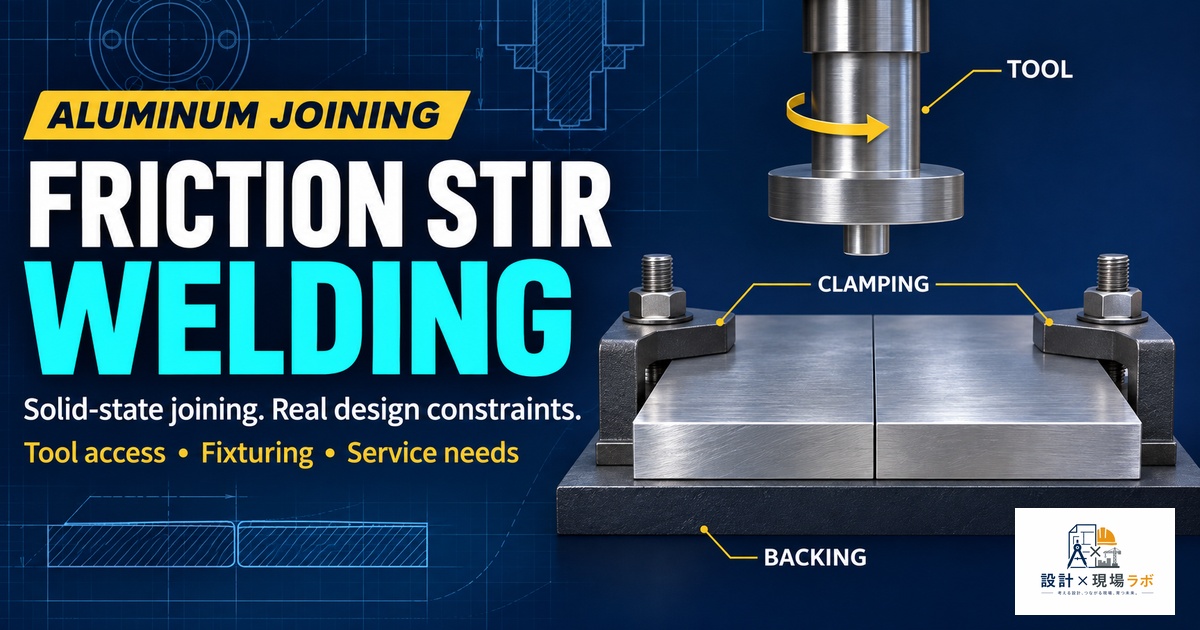
I first encountered friction stir welding on a rail vehicle component project roughly a decade into my career as a contract mechanical designer in Japan, and it genuinely changed how I think about joining aluminum structures. Coming from a background dominated by TIG and MIG welding of steel and aluminum alike, the idea of joining metal without ever melting it felt almost like a trick until I saw the cross-sections and the mechanical test data for myself. In the years since, I have specified or reviewed friction stir welding on everything from structural extrusions to sealed enclosure lids, and I want to share what I have learned about how the process actually works, where it earns its cost premium, and where I still choose conventional fusion welding instead.
- How Friction Stir Welding Actually Works
- Why It Matters So Much Specifically for Aluminum
- Applications Where I Have Specified Friction Stir Welding
- Distortion, Residual Stress, and Dimensional Stability
- Mechanical Properties: What the Data Actually Shows
- Where I Still Choose Conventional Welding Instead
- Reference
How Friction Stir Welding Actually Works
Friction stir welding uses a rotating, non-consumable tool with a shoulder and a probe (or pin) that plunges into the joint line between two workpieces clamped rigidly to a backing anvil. The rotating tool generates frictional heat that softens the material — without melting it, critically staying below the aluminum’s melting point — and the tool then traverses along the joint line, plastically stirring and forging the softened material from both sides together as it moves. The shoulder of the tool contains the plasticized material and applies forging pressure, while the pin does the actual stirring work down through the thickness of the joint.
What struck me most the first time I studied a friction stir weld cross-section under a microscope was how different the resulting microstructure looks compared to a fusion weld. There is no cast, dendritic solidification structure the way you get in a melted-and-resolidified fusion weld pool. Instead, you see a fine, recrystallized grain structure in what is called the “nugget” or stir zone, produced by severe plastic deformation rather than melting and solidification. That fine grain structure is a big part of why friction stir welds in aluminum alloys often show better mechanical properties, particularly fatigue performance, than a comparable fusion weld in the same alloy.
Why It Matters So Much Specifically for Aluminum
Friction stir welding was originally developed with aluminum in mind, and aluminum remains where the process delivers its clearest advantages, for reasons tied directly to how aluminum behaves during conventional fusion welding. Aluminum alloys, especially the higher-strength 2000, 6000, and 7000 series used in structural applications, are notoriously difficult to weld well with TIG or MIG. Many of the highest-strength aluminum alloys are essentially unweldable by fusion methods at all, because they are prone to severe hot cracking during solidification, or because the heat-affected zone loses so much of its strength from the welding heat that the joint becomes the weak point of the structure regardless of weld quality.
On a structural extrusion assembly for equipment mounted on a rail vehicle, the alloy specified for strength and weight reasons was a 6000-series aluminum that had a documented history of heat-affected zone softening under conventional TIG welding — post-weld testing on earlier programs using that alloy showed roughly 30-40% strength loss in the heat-affected zone compared to the base material. Friction stir welding on that same alloy showed a meaningfully smaller strength reduction in the affected zone, because the peak temperature reached during the process stays below the melting point and the overall heat input, while still enough to cause some softening in a heat-treatable alloy, is generally lower and more localized than a fusion arc process delivers. That difference was the deciding factor in specifying friction stir welding for the program despite the higher capital cost of the equipment involved.
Applications Where I Have Specified Friction Stir Welding
Beyond the rail vehicle structural extrusion example, I have seen and specified friction stir welding across a handful of recurring application types over the years. Long, straight or gently curved structural seams in aluminum extrusions — the kind used in rail vehicle bodies, marine structures, and some automotive space-frame applications — are the classic use case, because the process excels at long linear or near-linear joints where the tool can traverse a consistent path without the tight curvature that makes tool access difficult.
Sealed enclosure lids for electronics or battery packs are another application I have worked on directly. On a battery enclosure project where the lid needed to be welded to the base with a fully sealed, leak-tight joint and the aluminum housing could not tolerate the distortion that TIG welding around the full perimeter would introduce, friction stir welding produced a joint with low enough distortion that the enclosure held its flatness tolerance without a secondary straightening operation, and the joint passed helium leak testing without any porosity-related rework — porosity being a fairly common headache with fusion-welded aluminum seams that friction stir welding essentially avoids, since there is no melt pool to trap gas in the first place.
Tailor-welded blanks, where two sheets of different thickness or even different aluminum alloys are joined edge to edge before further forming, are a use case I encountered on an automotive-adjacent program, though less directly hands-on than the other examples. The ability to join dissimilar aluminum alloys, or aluminum to certain other materials in specialized variants of the process, with a solid-state joint that does not introduce the intermetallic brittleness issues fusion welding aluminum to dissimilar metals typically causes, opens up design options that conventional welding simply forecloses.
Distortion, Residual Stress, and Dimensional Stability
Lower distortion is one of the advantages I lean on most heavily when justifying friction stir welding to a program that is hesitant about its cost. Because the process never melts the base metal and the overall heat input tends to be lower and more localized than arc welding, the thermally induced distortion and residual stress in a friction stir welded assembly is typically significantly less than in a comparably sized fusion-welded aluminum structure. On the sealed battery enclosure project mentioned earlier, distortion was not just a cosmetic concern — it directly affected whether the lid would maintain the flatness needed for a reliable gasket seal against the base, and the friction stir welded lids held flatness within tolerance straight off the weld fixture, while early trial parts welded with TIG required a secondary flattening operation that added cost and introduced its own risk of cracking the heat-affected zone during straightening.
That said, distortion with friction stir welding is not zero, and I have seen engineers assume it is a distortion-free process, which is not accurate. The clamping fixture design matters enormously, because the process does apply significant downward and lateral force through the tool during welding, and inadequate clamping can allow parts to shift or lift slightly during the weld pass, producing its own dimensional problems distinct from thermal distortion. On an early trial for one program, insufficient clamping pressure along one edge of a long extrusion allowed a small gap to open during the weld pass, producing a localized region of incomplete bonding that only showed up on ultrasonic inspection — a fixture redesign with additional clamp points along that edge resolved it, but it was a reminder that friction stir welding trades thermal distortion risk for a different set of fixture and process control requirements, not a reduction to zero risk overall.
Mechanical Properties: What the Data Actually Shows
I want to be specific about mechanical properties rather than just asserting friction stir welding is “better,” because the real picture is more nuanced and depends heavily on the alloy and temper involved. For non-heat-treatable aluminum alloys (the 5000 series, for instance), friction stir welded joint strength often approaches or nearly matches the base material strength, because these alloys get their strength from work hardening and solid solution effects that are not as dramatically undone by the friction stir process’s heat and deformation as they would be by a fusion weld’s melting and slower cooling.
For heat-treatable alloys (2000, 6000, and 7000 series, which get their strength from precipitation hardening through heat treatment), friction stir welding still causes some strength reduction in the stir zone and the surrounding heat-affected zone, because the process temperature, while below melting, is still high enough to disrupt some of the fine precipitates responsible for the alloy’s strength. The reduction is real but is generally documented as smaller than what the same alloy shows after fusion welding, and post-weld heat treatment can recover some of that lost strength in applications where a post-weld heat treat cycle is practical.
| Alloy series | Strengthening mechanism | Typical FSW joint efficiency | Compared to fusion welding |
|---|---|---|---|
| 5000 series | Work hardening / solid solution | Often 90%+ of base metal | Comparable or modestly better |
| 6000 series | Precipitation hardening | Roughly 70-85% of base metal | Generally better |
| 7000 series | Precipitation hardening | Roughly 60-75% of base metal | Generally better, still limited |
| 2000 series | Precipitation hardening | Variable, alloy dependent | Generally better where fusion welding is even feasible |
Fatigue performance is where friction stir welding tends to show its clearest advantage over fusion welding, largely because the fine-grained, defect-free stir zone lacks the porosity, undercut, and solidification-related discontinuities that commonly act as fatigue crack initiation sites in a fusion weld. On the rail vehicle program, fatigue testing of friction stir welded joint samples showed meaningfully longer life under cyclic loading compared to archival TIG weld fatigue data on the same alloy, which was a significant part of the technical justification for the process given the vibration environment the structure would see in service.
Where I Still Choose Conventional Welding Instead
Despite my enthusiasm for the process, I do not specify friction stir welding by default, and there are real limitations that keep conventional TIG or MIG welding as the right choice in plenty of situations. The process fundamentally needs rigid backing and clamping, and it needs reasonable access to traverse the tool along the full joint length, which makes it poorly suited to complex three-dimensional joint geometries, tight internal corners, or repair work on an assembled structure where you cannot get a backing anvil in place. Capital equipment cost is also a real barrier — the machines are substantially more expensive than a TIG or MIG welding setup, and unless the production volume and quality requirements justify that investment, conventional welding remains the more practical choice.
On a low-volume prototype enclosure project where only a handful of units were needed and the joint geometry included several short, curved segments, I recommended sticking with TIG welding despite the aluminum alloy being reasonably friction-stir-weldable, purely because the fixture and tooling investment for friction stir welding could not be justified for that production quantity, and the curved, short-segment geometry would have made tool traverse difficult regardless. Matching the joining process to the actual production volume, geometry, and quality requirements, rather than defaulting to whichever process feels more advanced, is ultimately the same engineering judgment call that governs every joining decision I make, friction stir welding included.
Reference
Weld joint design has its own rules of thumb that are easy to get wrong without a dedicated reference.
Design of Welded Structures (Blodgett)
As an Amazon Associate I earn from qualifying purchases.


コメント