Twenty years into a career as a contract mechanical designer stationed inside major manufacturers, I have learned that the hardest part of the job is rarely the geometry. It is finding an unbroken stretch of time to think about the geometry at all. Design work — real design work, the kind where you are chasing tolerance stacks through an assembly or working out why a bracket keeps failing in fatigue testing — needs sustained attention. But the modern engineering floor is built to fragment that attention: chat pings, hallway questions, meetings that could have been an email, and the constant low hum of “got a minute?” I want to talk about what I have actually done, project after project, to carve out deep work in an environment that is actively hostile to it.
- Why Design Work Punishes Interruptions More Than Other Tasks
- Blocking Calendar Time Like It Is a Machine Reservation
- Managing the Chat and Email Reflex
- Using Physical Signals on a Shared Floor
- Sequencing Hard Problems Before the Day Gets Noisy
- Negotiating Focus Time as a Contract Engineer
- What Changes When You Actually Protect the Time
Why Design Work Punishes Interruptions More Than Other Tasks
Not all engineering tasks suffer equally from interruption. Filling out a change request form, updating a title block, or replying to a vendor email — these survive a five-minute break just fine. But holding a three-dimensional tolerance chain in your head, or tracing a stress path through a weldment, is a different kind of cognitive load. I once had a project where I was reworking a gearbox housing to fix a bearing preload issue. I had the whole chain in my head — bore tolerance, shim thickness, thermal growth of the aluminum case versus the steel shaft — and a colleague stopped by to ask about a completely unrelated part number. Ninety seconds of conversation. When I sat back down, it took me nearly twenty minutes to rebuild that mental model to the point where I trusted my own numbers again. That is the real cost of interruption in this line of work: not the ninety seconds, but the twenty minutes of reconstruction afterward that nobody sees on a timesheet.
I have come to think of design cognition as expensive to load and cheap to dump. You can destroy an hour of careful setup with a single tap on the shoulder. Understanding that asymmetry is the first step toward protecting it, because it means the goal is not just “fewer interruptions” but “fewer interruptions during the specific windows where you are holding something complex in your head.”
Blocking Calendar Time Like It Is a Machine Reservation
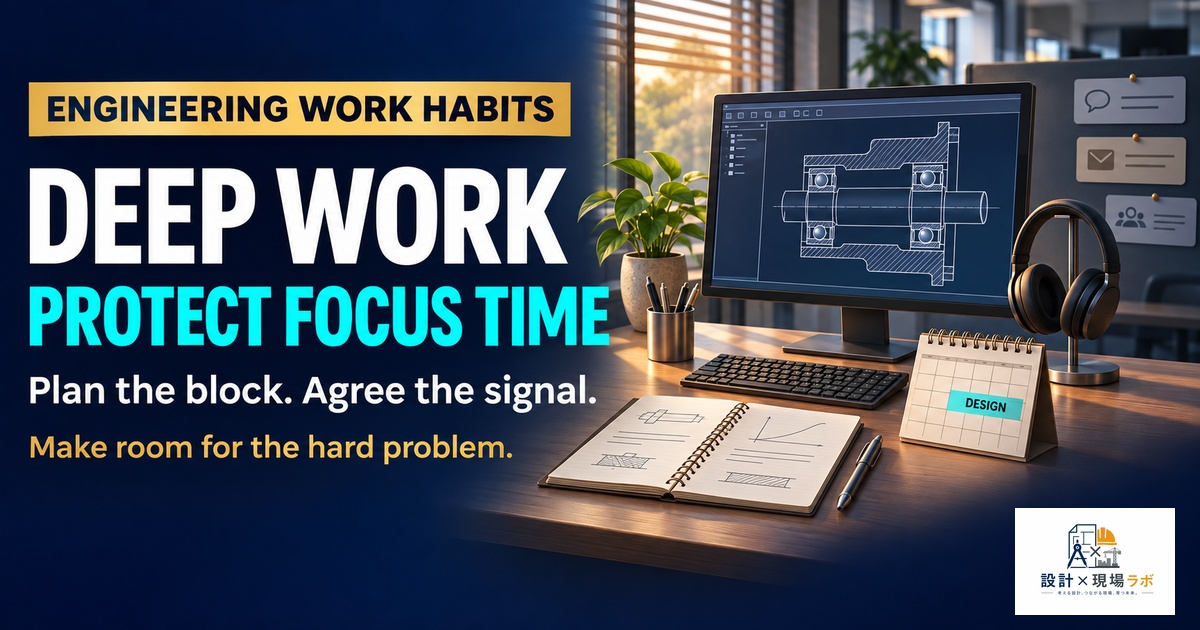
On the shop floor, nobody would dream of double-booking a CNC machine or a coordinate measuring machine. Everyone respects the reservation sheet. I eventually started treating my own attention the same way, blocking two-hour windows on my calendar labeled simply “design — do not disturb” and defending them with the same seriousness I would defend a CMM slot. At one manufacturer I was stationed at for nearly three years, this felt awkward at first, because contract engineers are often expected to be maximally available. But I found that once I explained the logic — that my output on the hard problems went up noticeably when I had protected blocks — my direct supervisor actually started scheduling design reviews around my blocks rather than through them.
The trick that made this work was picking the same two windows every day, typically the first ninety minutes after arrival and a stretch right after lunch, rather than floating them around. Predictability let colleagues learn my rhythm without me having to explain it every time. After a few weeks, people simply stopped messaging me during those hours, not because of a rule, but because they had absorbed the pattern.
Managing the Chat and Email Reflex
The instinct to check a notification the moment it arrives is, in my experience, the single biggest leak in deep work. I worked on a program where our team used an instant messaging tool for everything, including questions that genuinely had zero urgency. I noticed I was checking it every four or five minutes out of habit, not necessity, and each glance cost me a re-entry tax even when I did not reply.
What worked was batching. I closed the messaging client entirely during my blocked design hours and checked it at fixed points — before the block, at the midpoint break, and after. I told my team explicitly that I would be slow to respond during certain hours but fast right after, and in practice this traded almost nothing in responsiveness for a large gain in focus quality. The one exception I built in was a phone call escalation path for genuine emergencies, because on a production floor, a genuine emergency does happen occasionally, and you do not want your focus discipline to become a liability when a line is actually down.
Using Physical Signals on a Shared Floor
Open-plan engineering offices are common at the plants I have worked in, and body language turns out to matter more than any software setting. I started using a simple visual cue — headphones on meant deep focus, headphones around the neck meant approachable — and it took surprisingly little time for people around me to learn and respect it. On one contract, a younger designer told me months later that he had specifically waited to ask me a question because he had learned that “headphones on” meant I was mid-calculation and would give him a distracted, lower-quality answer anyway if he interrupted.
I have also found value in simply standing up and stepping away from my desk for questions that clearly are not urgent, rather than answering them at my workstation. It sounds trivial, but physically leaving my monitor means I am not staring at the drawing I was just working on, which makes it far easier to fully close that mental loop, deal with the question, and return fresh rather than half-distracted.
Sequencing Hard Problems Before the Day Gets Noisy
Interruption load is not constant through the day; it builds. Mornings, before most of the plant staff have settled in and before the day’s meetings start cascading, tend to be the quietest hours I get. I made it a habit years ago to identify the single hardest unsolved problem on my plate the night before, and to attack that specific problem first thing, before opening email or messaging apps at all. On a project involving a fixture redesign for a welding cell, the geometry constraints were genuinely difficult — six degrees of freedom to lock down with clearance for a robot arm that kept changing its approach angle as the process engineers iterated. I made real progress on that fixture almost exclusively in early morning sessions, because by 10 a.m. the day had usually fragmented into meetings and quick questions that made that kind of concentrated spatial reasoning nearly impossible.
This sequencing also has a psychological benefit. Solving the hardest thing early means the rest of the day, even if it turns into a string of interruptions, feels productive rather than like a battle you are constantly losing.
Negotiating Focus Time as a Contract Engineer
As an external engineer moving between client sites, I do not have the standing that a long-tenured employee might have to simply declare “I am unavailable.” Protecting focus time in that position requires a slightly different approach: making the request in terms the client organization already values. Instead of saying I needed quiet time for myself, I would frame it around deliverables — telling a project manager that a particular calculation or drawing package needed two uninterrupted hours to complete correctly, and asking whether that could be scheduled around other obligations for that day. Framed as protecting the deliverable rather than protecting my time, this request was almost never refused, because managers understand deadlines even when they do not naturally think about cognitive load.
I also learned to be explicit early in a contract about how I work best, rather than waiting until frustration built up. On a fairly demanding six-month assignment doing pressure vessel design, I mentioned in my first week that my accuracy on stress calculations was noticeably better in quiet blocks than in a constantly interrupted flow, and asked my supervisor directly whether that was something the team could accommodate. That single conversation early on did more to protect my time over the following months than any amount of after-the-fact enforcement would have.
What Changes When You Actually Protect the Time
The clearest evidence I have that this matters is not theoretical — it shows up in error rates. On projects where I successfully protected two or three hours of genuine focus time daily, my rework rate on drawings dropped noticeably, and I caught more of my own tolerance-stack mistakes before they reached a design review rather than after. On projects where my day was chopped into fifteen-minute fragments, by contrast, I found myself re-deriving the same numbers repeatedly and occasionally missing something that a calmer pass would have caught.
None of this requires elaborate systems. It requires deciding, deliberately, that some hours of the day belong to the hardest problem in front of you, and then defending those hours with the same seriousness you would defend a piece of test equipment that someone else wanted to borrow in the middle of a critical run. The interruptions on an engineering floor are not going away. But which ones reach you, and when, is still mostly within your control if you treat that control as worth exercising.


コメント