
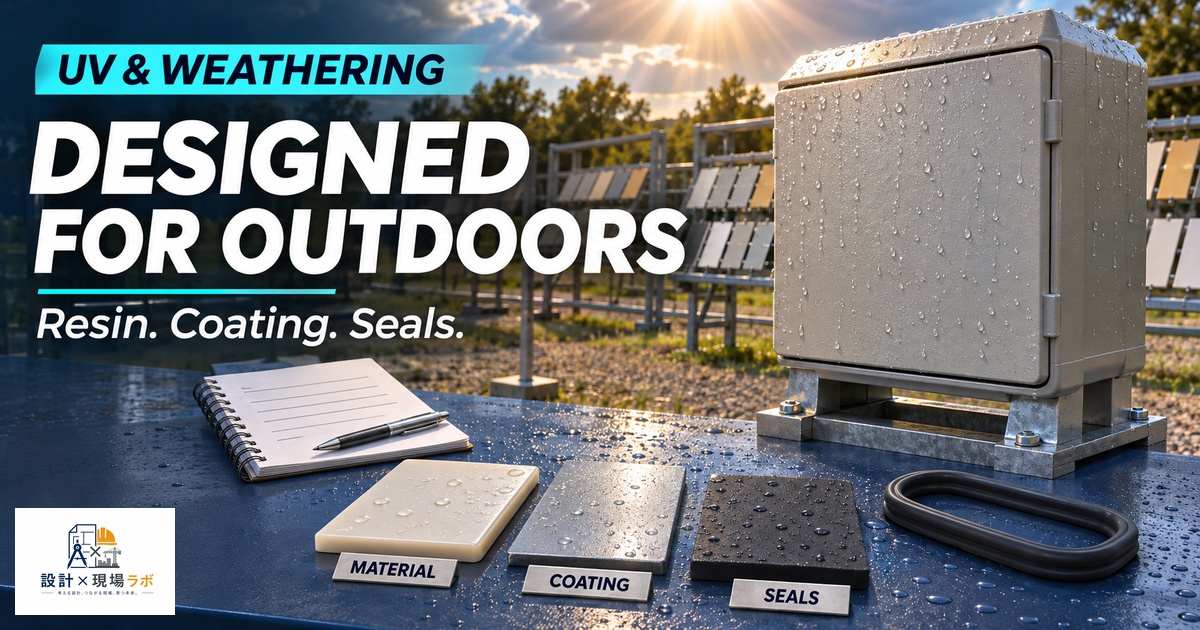
Twenty years designing production equipment as a contract mechanical engineer in Japan has put me on more than a few projects where the machine or enclosure had to survive outdoors, and outdoor duty changes the material conversation completely compared to anything destined for a climate-controlled factory floor. A plastic housing that looks perfect on day one can be chalky, brittle, and cracking within eighteen months if the resin and stabilizer package were chosen without UV exposure in mind, and I have been called in more than once to figure out why a field enclosure failed years ahead of its expected service life. This article covers how I actually select materials and coatings for equipment that has to survive real sun, real humidity swings, and real temperature cycling, based on projects where I got it right and at least one where I did not get it right the first time and had to learn from the failure.
- Resin Selection and Why “It’s UV Stabilized” Is Not Enough Detail
- Color and Pigment Effects on UV Degradation
- Coating Systems for Metal Enclosures and Structural Components
- Gasket and Seal Material Degradation Under UV Exposure
- Fastener and Hardware Corrosion in Combination With UV Exposure
- Testing and Validating Real-World Weathering Performance
Resin Selection and Why “It’s UV Stabilized” Is Not Enough Detail
Almost every plastics supplier will tell you their material is UV stabilized, but that phrase covers an enormous range of actual performance, from a resin with a token stabilizer package good for maybe a year of moderate exposure to one engineered for a decade outdoors. The difference usually comes down to the specific stabilizer chemistry and loading level, and I have learned not to accept “UV stabilized” as a specification without asking for the actual weathering test data behind it.
On an outdoor junction box enclosure I designed early in a project for agricultural equipment, I specified a standard UV-stabilized polypropylene based on the resin datasheet’s general claim of outdoor suitability, without digging into the specific accelerated weathering hours the claim was based on. After about fourteen months in service in a region with intense summer sun, several units came back with visibly chalked surfaces and measurably reduced impact strength – a drop test that the material had passed easily when new was now causing cracking. When I went back to the resin supplier with the failed parts, it turned out the “UV stabilized” claim was based on a stabilizer package rated for roughly 1000 hours of accelerated QUV testing, which translates to a service life more appropriate for indoor-with-window-exposure applications than genuine outdoor duty. I switched to a resin with a heavier hindered amine light stabilizer (HALS) loading rated for over 3000 hours of accelerated testing, which costs more per kilogram but has performed without visible degradation on the redesigned units now several years into field service.
Since that project, I always ask suppliers for the specific accelerated weathering standard and hour count behind any UV claim, and I try to get an actual sample exposed alongside my own reference materials rather than trusting a datasheet claim in isolation, especially for anything with an expected service life beyond two or three years outdoors.
Color and Pigment Effects on UV Degradation
Color choice interacts with UV resistance more than most people expect, because darker pigments, especially carbon black, actually improve UV resistance by absorbing UV energy before it can attack the polymer chain itself, while some lighter colors and certain pigment chemistries can accelerate degradation. This created a genuine conflict on a project where the client wanted a light gray enclosure color to match their existing equipment line, but light gray formulations using titanium dioxide as the whitening pigment, combined with certain UV stabilizer packages, can actually catalyze surface degradation under intense UV exposure through a photocatalytic reaction at the pigment particle surface.
I worked with the resin compounder to select a specific grade of titanium dioxide pigment that had been surface-treated to reduce this photocatalytic effect, rather than simply accepting whatever standard gray masterbatch was on the shelf. It added a modest cost to the material but avoided a degradation pathway that would have undermined the entire point of choosing a premium UV-stabilized base resin. I now treat pigment selection as part of the same UV resistance conversation as the base resin and stabilizer package, not a separate cosmetic decision made afterward.
Coating Systems for Metal Enclosures and Structural Components
For metal structures and enclosures, coating selection carries a similar weight to resin selection on plastic parts. Standard powder coat, while durable against mechanical damage, is not automatically UV-stable in its gloss and color retention – polyester powder coats generally hold up reasonably well outdoors, but standard epoxy powder coats chalk and fade relatively quickly under UV exposure despite being excellent for indoor corrosion protection.
On a structural frame for outdoor solar tracking equipment, the original coating specification called for a standard epoxy powder coat because that was the plant’s default coating line process for all their equipment, indoor or outdoor. I pushed to change the specification to a super-durable polyester powder coat rated for extended UV exposure, specifically formulated for architectural and outdoor applications, after calculating that the frame’s twenty-year expected service life would see the epoxy coating chalked and significantly faded within the first three to five years based on the coating manufacturer’s own weathering data. The cost difference was real – roughly 15 to 20 percent more per part for the coating material and slightly different cure parameters – but negligible compared to the cost of a field recoat program on equipment already deployed across dozens of remote sites.
| Coating Type | UV/Weathering Performance | Typical Application |
|---|---|---|
| Standard epoxy powder coat | Poor – chalks and fades within a few years outdoors | Indoor equipment, corrosion protection only |
| Standard polyester powder coat | Good – moderate gloss retention | General outdoor equipment, 5-10 year service |
| Super-durable polyester powder coat | Excellent – extended gloss/color retention | Long-service outdoor structures, architectural |
| Fluoropolymer (PVDF) coating | Excellent – industry benchmark for UV | Premium long-life outdoor, 20+ year applications |
| Anodizing (aluminum) | Excellent, inherently UV-stable | Aluminum structural and enclosure parts |
Gasket and Seal Material Degradation Under UV Exposure
Elastomeric seals and gaskets are frequently overlooked in outdoor UV planning because the enclosure and structural material get most of the attention, but a UV-degraded gasket that cracks or loses compression set resistance can undermine an otherwise well-sealed enclosure’s IP rating just as effectively as a cracked housing. Standard nitrile rubber, common and inexpensive for indoor sealing applications, degrades relatively quickly under UV exposure, becoming brittle and losing its sealing compression over one to two years outdoors in many climates.
On an enclosure door seal for outdoor telecom equipment, I initially carried over a nitrile gasket specification from a sister product designed for indoor use, an oversight that only got caught during a design review when a colleague specifically asked about the gasket’s UV rating. I switched to an EPDM (ethylene propylene diene monomer) gasket material, which has inherently good UV and ozone resistance due to its saturated polymer backbone lacking the double bonds that nitrile’s degradation mechanism attacks. EPDM costs somewhat more than nitrile and required a small adjustment to the gasket groove dimensions since the compression set characteristics differ slightly, but it avoided what would have been a widespread field seal failure across an entire product line months or years after deployment.
Fastener and Hardware Corrosion in Combination With UV Exposure
UV degradation rarely happens in isolation outdoors – it combines with humidity, temperature cycling, and often salt air or industrial pollutants depending on the site, and I have learned to think about these combined effects together rather than addressing UV resistance and corrosion resistance as separate specifications handled by different parts of the design. Standard zinc-plated fasteners that would last indefinitely in a dry indoor environment can develop red rust within a year or two at an outdoor coastal site, and a rusted fastener head can also become a stress concentration point that accelerates cracking in an otherwise sound structural connection.
On the same solar tracker frame project mentioned earlier, I specified stainless steel fasteners throughout rather than the plant’s standard zinc-plated hardware, specifically because the deployment sites included several coastal locations with significant salt air exposure alongside intense UV. The cost premium for stainless fasteners across the whole frame was a few percent of total material cost, which was easy to justify against the alternative of a field hardware replacement program a few years into a twenty-year expected service life.
Testing and Validating Real-World Weathering Performance
Accelerated weathering testing in a QUV or xenon arc chamber is useful for comparing materials and catching gross problems early, but I have learned not to treat accelerated test results as a perfect substitute for actual field exposure data, because accelerated tests use a specific and somewhat artificial UV spectrum and intensity that does not always correlate linearly to real sun exposure across all material types. Where the program timeline allows it, I try to get actual outdoor exposure racks running in parallel with accelerated chamber testing, placing sample coupons of the actual material and coating combination at a real outdoor test site, ideally somewhere with intense sun exposure, and pulling samples at intervals to physically check color, gloss, and mechanical properties against the chamber-tested equivalents.
This dual approach caught a discrepancy on one project where accelerated chamber testing showed a coating performing acceptably at the equivalent of roughly five years of exposure, while actual outdoor rack samples at a similar elapsed real-time exposure showed more visible chalking than the chamber data predicted, a mismatch traced back to a difference in UV spectrum distribution between the xenon arc chamber and actual sunlight at that particular site’s altitude and latitude. Having both data sets available let us make a more informed final material decision than either test alone would have supported, and it is a practice I now build into any outdoor equipment program with enough schedule runway to support it.
コメント